BIONICLE Chronicles #1: Tale of the Toa
“Onua — Toa of Earth”
Written by C.A. Hapka
Dig, pull, scrape, push. Dig, pull, scrape, push.
Onua fell into comfortable rhythm as he scooped out a new tunnel. When he had noticed the cave entrance and swiftly embraced the pleasant darkness, he had felt much better. He was happy to be underground.
But he still felt uneasy Aside from his name, he didn’t know anything about who or where he was. And he couldn’t shake the feeling that he was somehow missing something — missing a piece of himself.
But he didn’t exactly feel at home. He knew nothing aside from his name — not where he is, nor who he is. Moreover, he couldn’t do away with the thought that something was amiss — something that’s part of him.
This is only due to the lack of knowledge, he thought to himself, as he shoveled another clump of dirt from the ever-growing tunnel. Of course I’m feeling strange when I don’t even know who or what I am.
But he pushed that worry aside, continuing his work. There was no sense in wasting energy fretting over what he couldn’t control. All he could do was control what he could — like the digging.
But why was he digging? Onua stopped and frowned. Something had made him start this tunnel. Though why, what is his goal?
…The knowing will come…
The thought surprised Onua. Was he the one thinking it? It almost felt like it had come from outside, like those faded, distressing dreams from before he had awakened…
“No matter,” he murmured, reaching out for another clump of earth. “Knowledge won’t come when we’re just idly waiting for it.”
He forced himself back to work. It was easy to shove aside the questions, and it was easy to submerge in the joy of working with earth. Deep within his consciousness, though, the questions remained, heavy, thick and solid with mysteriousness.
Soon he had already dug at least a hundred lengths through the solid earth. On the surface, his sight was weak and faint, but his eyes had easily adapted to the darkness of the tunnel, allowing him to see well.
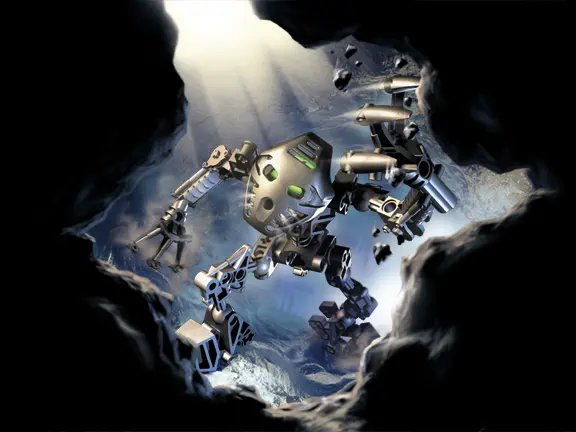
Onua powered his huge hand forward through a rocky section of the tunnel wall. It met empty air instead of earth and rock. Interesting.
Pushing through with a shower of stones and clay, Onua found himself in a large cavern. In the center, a tower of rock ended in a flat stone platform. Atop it, a lightstone glowed.
He spotted a tunnel in the far wall of the cavern and followed it.
Turning a corner, he was startled to see a familiar-looking figure at the center of a large mural.
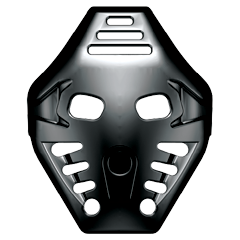
“Is that — me?” he whispered, reaching out to touch the delicately sculpted image. It portrayed a powerful-looking figure with a wedge-shaped mask and large clawed hands. The figure was standing among five other, similar figures. Standing opposite the group was a horde of frightening creatures, enormous lizards, scorpions and a pair of formidable, crablike monsters. What are these? And who are those figures surrounding him?
But most importantly, what was a picture of him doing on the wall when he had just arrived here?
As Onua gently touched the lines of the carving with one of his clawed fingers, he felt a strange vibration in the wall. Stepping forward, he put his head to it, listening intently.
Thunka, thunka, thunka, thunka, thunka…
It was a steady rhythm. Onua had no idea what it meant. But he planned to find out. With one last glance at the picture of himself, he turned and continued down the tunnel, keeping one hand on the wall to follow the vibrations.
The pulsing grew stronger and stronger — and with the next twist of the tunnel, Onua found what he was looking for. Another enormous cavern lay before him, lit by more lightstone platforms. Dozens of stone columns stretched up to the high ceiling. Between these columns were paths made of cobblestones set into the earthen floor. Stone benches stood beside the paths, and a small, clear stream trickled through the cavern, with graceful stone bridges arching above it in various spots.
Stepping forward, he saw that the little stream emptied out into a still, round pool lined with pebbles. In the center, reddish-brown gemstones spelled out a word:
ONU-KORO
Onu-Koro — what did that mean? What kind of connection did it have with his name, which had a similar sound to it?
The figure glanced over his shoulder, then stopped short. “Oh!” he exclaimed. “Oh, oh.”
Onua frowned. Perhaps this being didn’t speak the same language as he did. He cleared his throat. “Hel-lo,” he said as slowly and clearly as he could. “Me — Onua.” He put a hand to his chest, then pointed toward the other. “Who — you? Do — you — understand — me?”
“Oh, yes!” the small figure cried and rushed toward him. He slid to a halt, bending into a sort of hurried bow. “Oh, Toa Onua — we have been waiting for you such a long time! And how long! Come, please — Turaga Whenua will want to see you right away.”
Confused, Onua followed him through the archway carved into the cavern wall. “You know my name,” he said. “But I don’t know yours.”
Onepu led the way through a series of tunnels and caverns. Soon they reached another large cavern. On each wall, a series of carved-out dwellings climbed nearly to the ceiling.
“I see,” Onua replied, storing this data in his head. He also noted that the Matoran had been wearing a mask that looked almost like his own, just a bit smaller. “Well, I have another question, Onepu. Why did you call me a Toa?”
“The Turaga will explain everything,” Onepu said in an excited tone. “This is too big a task for me, and besides, this matter is far too important and urgent. We have no time to lose.”
Onepu lead him across a row of tunnels and caves. Despite the darkness, he was moving really fast. Soon, they arrived at another giant cavern, nearly as big as where he had discovered the park. Lining its walls were huts carved into stone, almost reaching up to the ceiling.
Onua blinked, trying to take in all of these staggering sights. So Onepu and others like him really live down here? Suddenly all of this began to make sense. If he had felt so much better deep under the earth, why couldn’t others feel the same way?
“Wait here, please, Toa,” Onepu said, gesturing toward a large stone bench near the fountain. “I will fetch the Turaga.”
Onua nodded, and the Matoran rushed off. Onua didn’t sit down, he instead took the opportunity to look around. At the center of the cavern was a fountain filled with crystal-clear water. A sculpture arose from the pool, spouting water out of several spots.
Gazing at his own statue, he pondered with a heavy heart what other kinds of strange surprises may await him in this new world.
As he took a step forward, his foot touched the small stone wall surrounding the fountain. He felt a strong, solid and familiar rhythm: Thunka, thunka, thunka, thunka, thunka. There was no telling what sort of machinery was pumping the water, but it had to be the source of the vibrations he had picked up on the wall with the relief. Now that he listened closely, he realized it could even faintly be felt through the cave’s floor as well.
He was still staring at the fountain when he heard someone behind him. Turning, he saw a figure much like Onepu, but a bit taller and with a different mask. The eyes behind that mask held patience, caution, and great wisdom.
“I am Whenua, Turaga of this village,” the stranger said, bowing. “Welcome, Toa Onua. We have been waiting for you.”
“Yes, so I’ve heard,” Onua replied. “And I’ve been awaiting some clue about who I am and what I’m doing here.”
“The legends said that would be the case,” Whenua said. “It was said that the Toa, when they arrived, would remember very little beyond scraps of dreams and fragments of their purpose.”
Whenua nodded. “There are five others,” he said. “Each of you draws his power from a different element — yours is the earth itself, perhaps the strongest of all. This underground world is your home, but even beyond these caves, you have the ability to melt earth with your will. Your purpose is to use that power to face and fight a mighty evil — Makuta.”
Though Onua wasn’t sure why, the name sent a chill through him. An image floated into his mind — dark, empty eyes in an even darker face shrouded with gray smoke.
“He is the darkness, the essence of chaos and emptiness and fear, the spirit of destruction,” Whenua replied in a trembling voice. “His strength is unmatched, and it is said that only the Toa have the power to stand against him.”
Whenua shook his head sadly. “It serves no purpose to be false, for the earth cannot be deceived,” he said. “Nothing about your quest is certain, except that it is your duty to try. That is all that any of us can do in this life.”
Onua nodded. The Turaga’s words rang true. Now he knew what he had felt was missing: his duty. But that feeling was gone. “I will do what I can,” he promised solemnly. “But first, you must tell me all you know of these powers you say I have.”
“Of course, Toa,” Whenua said. “For that is my duty. First, you should know that the power itself comes from within you, but it is focused through your mask — the Pakari, the Great Mask of Strength.”